
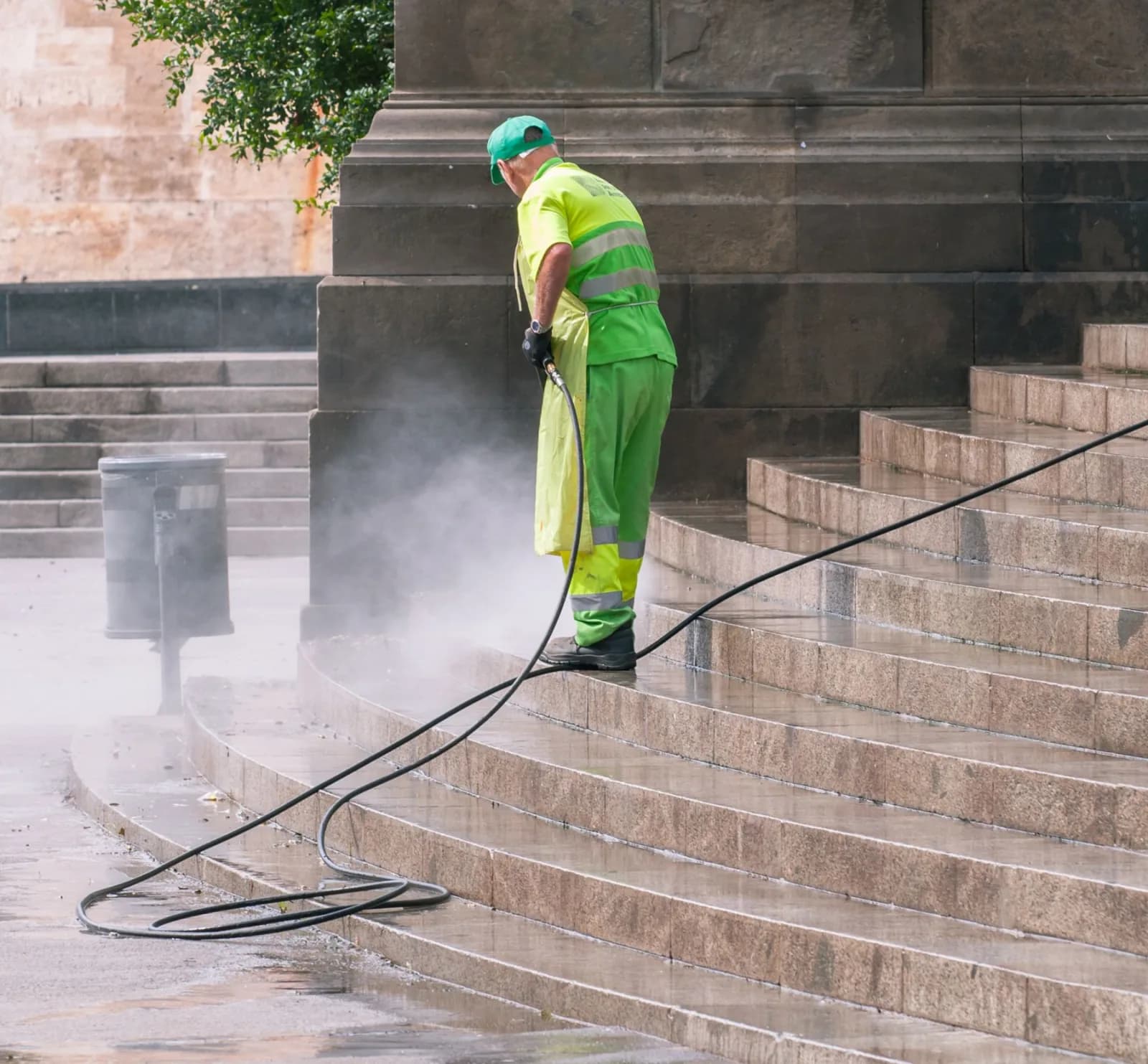
Slip exposure,
washed away.
Sidewalks, dock aprons, building exteriors and parking structures — cleaned with attention to runoff and surface type.
- Sidewalks, entryways and walkways
- Loading docks, dock aprons and grease-loaded surfaces
- Building exteriors, awnings and facades
- Parking lots and parking structures
Exterior surfaces are a liability question before they are an appearance question. Grease-tracked dock aprons and slick walkways are slip exposure. Nexara pressure washes commercial exteriors on a schedule, with surface-appropriate pressure and attention to where the water goes.
What's included.
- 01
Sidewalks, entryways and walkways
- 02
Loading docks, dock aprons and grease-loaded surfaces
- 03
Building exteriors, awnings and facades
- 04
Parking lots and parking structures
- 05
Graffiti and gum removal
How do you decide how much pressure a surface can take?
Nexara matches pressure and method to the substrate: dock aprons and drive lanes tolerate high-PSI hot-water washing, while stucco, EIFS, painted siding and aluminum storefronts get soft washing — low pressure with a cleaning solution doing the work instead of force.
Pressure washing method by surface
Dock apron / drive lane concrete
- Typical method
- Hot-water pressure wash, 3,000+ PSI
- Why
- Dense concrete tolerates high force; grease and tire marks need heat and pressure
Sidewalks and entry walkways
- Typical method
- Pressure wash, moderate PSI
- Why
- Foot traffic surface; gum and staining removal without undercutting joints
Stucco / EIFS / painted siding
- Typical method
- Soft wash, low PSI + solution
- Why
- High pressure can strip paint, drive water behind cladding, or crack EIFS
Storefront glass and metal trim
- Typical method
- Soft wash or hand detail
- Why
- Prevents etching, streaking and gasket damage
Parking structure decks
- Typical method
- Pressure wash with containment
- Why
- Oil staining removal; runoff typically drains to a controlled outlet, not a street inlet
| Surface | Typical method | Why |
|---|---|---|
| Dock apron / drive lane concrete | Hot-water pressure wash, 3,000+ PSI | Dense concrete tolerates high force; grease and tire marks need heat and pressure |
| Sidewalks and entry walkways | Pressure wash, moderate PSI | Foot traffic surface; gum and staining removal without undercutting joints |
| Stucco / EIFS / painted siding | Soft wash, low PSI + solution | High pressure can strip paint, drive water behind cladding, or crack EIFS |
| Storefront glass and metal trim | Soft wash or hand detail | Prevents etching, streaking and gasket damage |
| Parking structure decks | Pressure wash with containment | Oil staining removal; runoff typically drains to a controlled outlet, not a street inlet |
Getting this wrong runs both directions. Too little pressure on a dock apron leaves grease behind. Too much on a building facade drives water past the weatherproofing or blasts mortar joints. The scope Nexara writes for a property names the surface, the method and the frequency before a crew shows up — floor care follows the same logic indoors on VCT, terrazzo and sealed concrete, and manufacturing and warehouse sites usually need both.
Where does the wash water go?
Wash water is not stormwater. The Inland Empire's municipal stormwater permits require cities to prohibit or control discharges of wash water from pressure cleaning and from cleaning parking lots, sidewalks and plazas, so on a commercial job it gets contained and recovered rather than left to run to the gutter.
This is the detail a one-line quote tends to skip. The San Bernardino County MS4 permit (Order No. R8-2010-0036) lists “wash water from … steam and pressure cleaning” and “water from cleaning of … parking lots, streets, sidewalks, driveways, patios, plazas” among the discharges its cities must prohibit or control Santa Ana Regional Water Quality Control Board — Order R8-2010-0036. The county's own business guidance asks operators to cut runoff from parking lots and loading docks and to send floor-cleaning water to the sewer, not the parking lot San Bernardino County Stormwater Program. Published best-management practices for mobile power washing, such as Sonoma County's Streets to Creeks program, call for protecting storm drain inlets and collecting wash water with a portable wash pit or vacuum recovery unit Streets to Creeks — Mobile/Portable Power Washing BMPs.
- Grease, oil residue and degreasers from a dock apron are treated as pollutants, not just dirty water
- A vacuum recovery unit or portable berm keeps wash water out of the nearest inlet while a crew works
- Where the property allows it, contained water can be released to a landscaped area or sanitary cleanout instead of the street
- The containment method and the disposal point are named in the scope before the job, so the property knows where its wash water went
What exterior surfaces get pressure washed?
Sidewalks, entryways, dock aprons, building exteriors, awnings and parking structures, plus localized gum or graffiti removal. Each surface is scoped separately in the written program because the soiling type, the substrate and the acceptable method differ across every one of them.
- Sidewalks, entryways and walkways — slip risk from grime and algae film
- Loading docks and dock aprons — grease, tire marks, cardboard residue
- Building exteriors, awnings and facades — atmospheric soiling, mildew streaking
- Parking lots and parking structures — oil staining, tire marks, general grime
- Graffiti and gum removal — localized, spot-treated rather than a full-surface wash
A single property often needs several of these on entirely different cycles — a dock apron every month, a facade once a year — which is why a one-line 'pressure washing' quote without a surface breakdown is usually a sign the scope hasn't actually been thought through.
Why treat exterior cleaning as a liability issue, not a cosmetics one?
A grease-tracked dock apron or an algae-slick entry walkway is a slip-and-fall exposure before it is an appearance problem. Scheduled pressure washing removes the film that causes falls, and documents when it was last done if a claim is ever filed.
Property managers rarely think about a walkway until someone falls on it. By then the question isn't whether it looked dirty — it's whether there's a record showing when it was last cleaned and on what schedule. That record is part of what a written scope gives a property: a defensible answer, not a guess.
How often should exteriors be pressure washed?
Nexara's starting points in a written scope: dock aprons and high-grease areas monthly to quarterly, sidewalks and entries quarterly to semi-annually, and building facades every one to two years. Climate, traffic and the surface's soiling rate move the schedule in either direction.
Starting frequencies Nexara uses in a pressure washing scope
Dock aprons / grease zones
- Typical frequency
- Monthly – quarterly
- Driver
- Continuous grease and cardboard traffic
Sidewalks / entries
- Typical frequency
- Quarterly – semi-annually
- Driver
- Foot traffic film, gum, algae
Parking structures
- Typical frequency
- Semi-annually – annually
- Driver
- Oil staining, tire marks
Building facades / awnings
- Typical frequency
- Annually – biennially
- Driver
- Atmospheric soiling, mildew
| Area | Typical frequency | Driver |
|---|---|---|
| Dock aprons / grease zones | Monthly – quarterly | Continuous grease and cardboard traffic |
| Sidewalks / entries | Quarterly – semi-annually | Foot traffic film, gum, algae |
| Parking structures | Semi-annually – annually | Oil staining, tire marks |
| Building facades / awnings | Annually – biennially | Atmospheric soiling, mildew |
This pairs directly with parking lot sweeping — sweeping keeps loose debris and grit off the surface between washes, so the pressure wash isn't re-fighting the same dirt every visit. Properties near Fontana and Rancho Cucamonga distribution corridors typically run the tightest dock-apron schedule because of continuous truck traffic.
Which properties need scheduled exterior washing most?
Distribution and logistics facilities with dock traffic, retail centers and restaurant pads with grease and food debris, HOA and office-park common areas, and industrial sites with equipment staging outdoors all carry exterior soiling that a one-time wash doesn't solve.
- Distribution and logistics facilities — dock aprons, drive lanes, trailer staging
- Retail centers and restaurant pads — grease, gum, food debris at entries
- Property managers and HOA commercial areas — sidewalks, common-area facades
- Industrial and manufacturing sites — equipment yards, loading zones
What facility managers ask us.
Do you handle wash water containment yourselves, or is that on the property?
The containment method — berms, a wash pit or vacuum recovery, depending on the surface and site — is named in the written scope before work starts, along with who handles inlet protection and where recovered water goes. Get that answer in writing from any vendor.
Will pressure washing damage stucco or painted surfaces?
Not with the right method. Stucco, EIFS and painted siding get soft washing — low pressure, cleaning solution doing the work — while dense concrete on a dock apron tolerates far more force. Matching the method to the surface is the job, not an afterthought.
Can you remove oil stains from a parking lot?
Fresh staining lifts with hot-water pressure washing and a degreaser. Older, deeply set staining may lighten rather than fully disappear — that's assessed on site, and Nexara won't promise a full removal it can't deliver.
How is graffiti removal different from a regular wash?
It's spot-treated rather than run across the full surface — a different chemical approach depending on the paint type and substrate, sometimes multiple passes. It's scoped as its own line item, not folded into a routine wash.
Do you pressure wash in winter or during rain?
Scheduling avoids active rain, since runoff containment and effectiveness both suffer. Cold doesn't stop the work in Southern California's climate, but standing water or saturated ground near a wash area does delay it.
Is pressure washing safe for solar panels or rooftop equipment?
Rooftop equipment and solar arrays are outside standard exterior pressure washing scope — they need manufacturer-specific methods and are typically handled by a specialized vendor, not a general facility cleaning program.
Can pressure washing replace parking lot sweeping?
No — they solve different problems. Sweeping removes loose debris, litter and grit before it becomes airborne dust or drain sediment; pressure washing removes bonded staining and grime. Most properties run both on a paired schedule.
Who regulates wash water reaching a storm drain in the Inland Empire?
Cities do, under the regional stormwater permit. San Bernardino County's permit requires its cities to prohibit or control wash water from pressure cleaning and from cleaning parking lots and sidewalks, and cities enforce that through their own ordinances. The discharge happens on the property, which is why runoff handling belongs in the written scope. See Ontario for how this applies locally.
- Santa Ana Regional Water Quality Control Board — San Bernardino County MS4 Permit, Order No. R8-2010-0036 (section on prohibited discharges)
- San Bernardino County Stormwater Program — Pollution Prevention Tips for Businesses
- Streets to Creeks (Sonoma County Water Agency) — Mobile/Portable Power Washing BMPs
Reviewed by Nexara Facility Services · Updated
Other services.
- Janitorial & Commercial CleaningJanitorial
- Floor Care & Hard Surface MaintenanceFloor Care
- Concrete & Natural Stone PolishingStone Polishing
- Commercial Carpet CleaningCarpet Cleaning
- Commercial Window CleaningWindow Cleaning
- Day Porter ServicesDay Porter
- High DustingHigh Dusting
- Parking Lot SweepingLot Sweeping
- Post-Construction CleanupConstruction Cleanup
No proposal before a walkthrough
Let's walk your facility.
Every scope starts with a walkthrough. We look at the building, ask what is actually going wrong today, and come back with a written scope and a number — not a brochure.