
Glass that never
needs asking about.
Interior and exterior glass on a schedule — storefronts, curtain wall, atriums and hard-water restoration.
- Interior and exterior glass on a recurring schedule
- Storefront, curtain wall and atrium glass
- Frame, track and sill detailing
- Hard-water and mineral stain restoration
Glass is the first thing a visitor, an auditor or a prospective tenant sees. Nexara cleans commercial glass on a defined schedule so it never reaches the point where someone has to ask about it, and handles the hard-water staining that Inland Empire buildings accumulate from sprinkler overspray.
What's included.
- 01
Interior and exterior glass on a recurring schedule
- 02
Storefront, curtain wall and atrium glass
- 03
Frame, track and sill detailing
- 04
Hard-water and mineral stain restoration
- 05
Post-construction glass cleaning
What's covered in interior vs. exterior commercial window cleaning?
Interior window cleaning covers glass, frames, tracks and sills reachable from inside the building on a standard schedule. Exterior cleaning covers storefront, curtain wall and atrium glass from the outside, and — above ground level — brings in access equipment and safety requirements that interior work doesn't need.
- Interior glass, frame, track and sill detailing on a recurring schedule
- Exterior storefront and low-rise glass, typically reached from ground level or a ladder
- Curtain wall and atrium glass, which may require lift access or rope access depending on height
- Post-construction glass cleaning to remove film, overspray and construction residue
Frame, track and sill detailing is easy to leave out of a scope entirely, but it's usually where dirt accumulates fastest and where it's most visible to anyone standing at an entrance. A window that's spotless but sitting in a grime-lined track still reads as a building nobody's maintaining.
How often should commercial windows be cleaned?
As starting points in a written scope, Nexara plans storefronts and high-visibility glass monthly and office building exteriors quarterly. Buildings near landscaping with sprinkler overspray need more frequent attention, because the mineral deposits that overspray leaves behind become harder to remove — and eventually permanent — the longer they sit.
Starting frequencies Nexara uses in a window scope, adjusted after the walkthrough
Retail storefront
- Typical frequency
- Monthly
- Why
- First impression, highest visibility to customers
Office exterior
- Typical frequency
- Quarterly
- Why
- Lower foot traffic, less immediate visibility
Glass near irrigation/landscaping
- Typical frequency
- Monthly or more
- Why
- Sprinkler overspray accelerates mineral buildup
Interior glass partitions
- Typical frequency
- As part of recurring janitorial
- Why
- Tied to the standard nightly cleaning cycle
| Setting | Typical frequency | Why |
|---|---|---|
| Retail storefront | Monthly | First impression, highest visibility to customers |
| Office exterior | Quarterly | Lower foot traffic, less immediate visibility |
| Glass near irrigation/landscaping | Monthly or more | Sprinkler overspray accelerates mineral buildup |
| Interior glass partitions | As part of recurring janitorial | Tied to the standard nightly cleaning cycle |
Frequency isn't just about appearance. Glass left too long between cleanings accumulates a film that's harder to remove with each passing cycle, which is how a quarterly schedule quietly turns into a semi-annual restoration job. Setting the right frequency up front is cheaper than catching up on neglected glass later.
Why does glass in the Inland Empire stain with hard-water spots?
Cucamonga Valley Water District describes its water as “moderately hard” to “hard,” ranging 81–190 mg/L, or approximately 8 grains per gallon — hard enough that sprinkler overspray and irrigation drift leave visible mineral deposits on glass and frames if not cleaned before they dry and etch the surface.
Hard water leaves calcium and mineral residue behind as it evaporates. On glass near landscaping, sprinklers or drip irrigation, that residue accumulates with every watering cycle. Left long enough, the minerals can etch the glass surface itself rather than sitting on top of it — at which point cleaning no longer restores the glass, and only replacement does.
Restoration is assessed in person, because there's no way to tell from a description alone whether a deposit is still surface-level or has already etched the glass.
The same overspray that spots glass also leaves residue on adjacent frames, sills and nearby hardscape, which is why hard-water restoration is usually scoped together with a look at the irrigation pattern causing it. Fixing the spray direction or run time on a sprinkler head is often cheaper than repeatedly restoring the glass it keeps hitting.
Can hard-water stains actually be removed from glass?
In most cases, yes — if the mineral deposit hasn't yet etched the glass. Restoration methods work on surface deposits sitting on top of the glass; once minerals have etched into the surface itself, cleaning can't reverse it and the only remaining option is replacement.
Restoration methods for surface-level mineral deposits are more aggressive than routine cleaning and are not appropriate for every glass type or coating — some low-E and coated glass products can be damaged by the wrong restoration approach, which is another reason it's assessed rather than applied as a default.
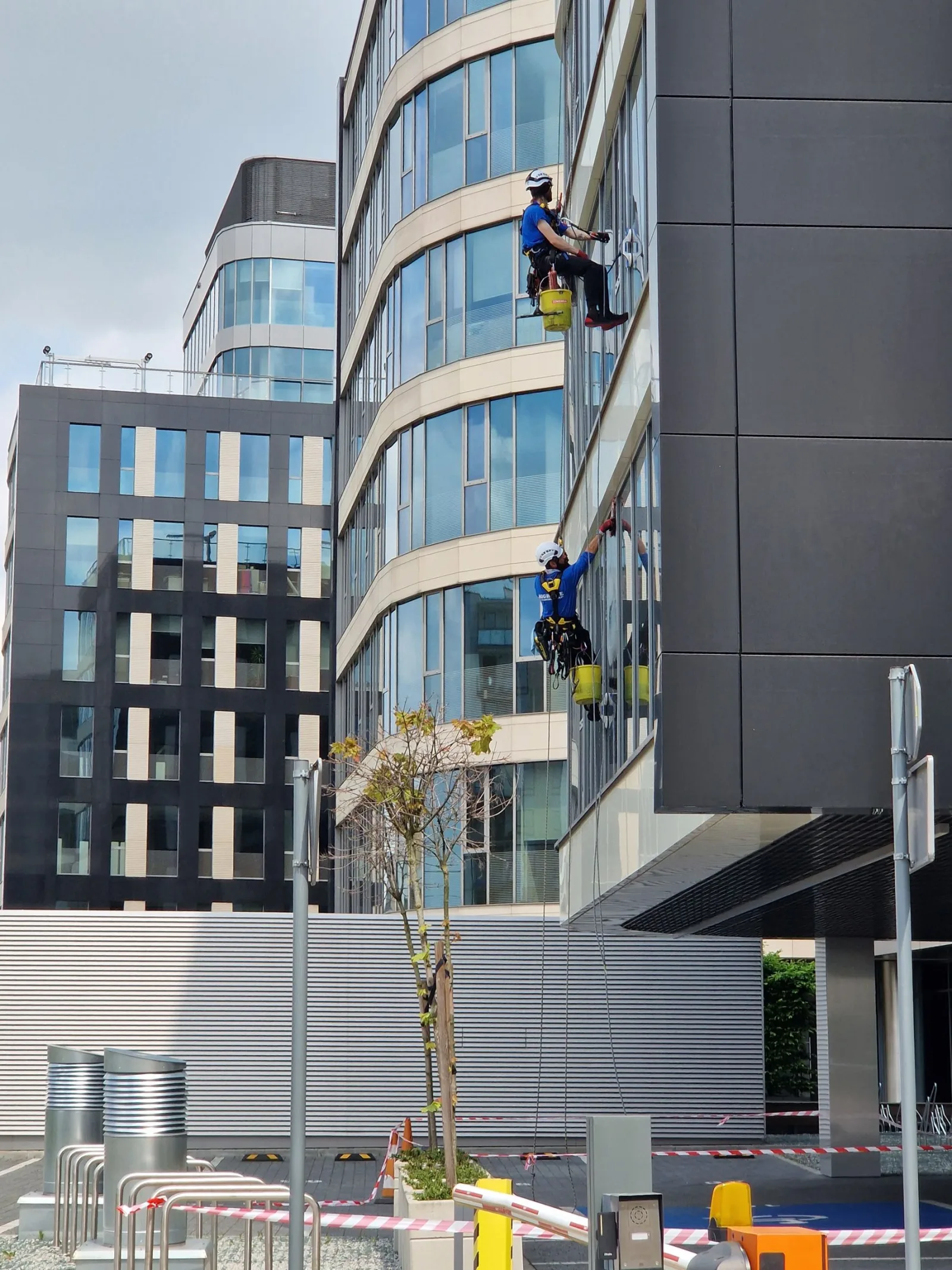
How is high-access exterior glass cleaned safely on taller buildings?
Exterior glass above ladder or lift reach is often cleaned from rope descent systems. OSHA's 29 CFR 1910.27 requires each anchorage to support at least 5,000 pounds per attached worker, be inspected annually by a qualified person, and be certified as necessary and at least every 10 years, and it generally caps rope descent at 300 feet.
Building owners carry real obligations under this standard: before a rope descent system is used, the owner must tell the employer in writing that each anchorage has been identified, tested, certified and maintained. A vendor proposing rope access on a building should ask for that letter, and a facility manager should be able to produce it.
Low-rise work — most storefronts, single-story retail and typical office exteriors — is reached with ladders or a lift and doesn't require rope access at all. The access method is matched to the building, not applied uniformly, and a facility manager evaluating a vendor for taller glass should ask which method they're actually using before assuming rope access is involved at all.
When does window cleaning happen outside the recurring schedule?
Post-construction cleanup is the most common exception — new or renovated glass carries film, overspray and construction dust that a standard recurring visit isn't scoped to remove, so it's cleaned once as its own pass before the building opens or the recurring schedule starts.
See post-construction cleaning for how that first pass is scoped separately from the ongoing schedule, and pressure washing for exterior surfaces below the glass line that get cleaned on their own cycle.
For retail and office buildings in Ontario, Riverside and the rest of the Inland Empire, Nexara writes these into one annual plan: a recurring interior and exterior schedule, a hard-water check built into the same visit, and one-off post-construction passes scoped as they come up, rather than negotiating each visit separately.
What facility managers ask us.
How often should commercial windows be cleaned?
As a starting point, Nexara plans storefronts and high-visibility glass monthly and office exteriors quarterly, then adjusts after seeing the building. Buildings near landscaping with sprinkler overspray need more frequent attention to prevent mineral etching, which becomes permanent if left long enough.
Can you remove hard water stains from glass?
In most cases, yes — if the mineral deposit has not yet etched the glass. Restoration is assessed in person, because once glass is etched the only remedy is replacement.
Why is hard water a bigger problem for glass in the Inland Empire?
Local water is described as moderately hard to hard by area water districts, including Cucamonga Valley Water District (81–190 mg/L). Combined with sprinkler and drip irrigation overspray on landscaped buildings, that mineral content leaves visible deposits on nearby glass faster than in areas with softer water.
Is rope access required for all exterior window cleaning?
No. Rope descent systems are only used on buildings tall enough that a ladder or lift can't safely reach the glass. Most storefronts and low-rise office exteriors are cleaned from the ground or a lift, which carries its own but different safety requirements.
What should a building owner ask before hiring a rope-access window cleaner?
Ask how they will confirm the anchorages. Under OSHA 1910.27 the building owner must inform the employer in writing that each anchorage is identified, tested, certified and maintained, based on an annual inspection. A careful vendor asks for that letter before the first drop.
Is interior glass cleaning included in a recurring janitorial contract?
It can be. Interior glass at entries and partitions is often scoped into the recurring janitorial services program, while exterior and high-access glass is typically scheduled on its own separate frequency.
Do you clean windows after construction or renovation work?
Yes — post-construction glass carries film, overspray and dust that a standard recurring visit isn't scoped to remove, so it gets a dedicated first pass. See post-construction cleaning for how that scope is defined.
What areas does Nexara serve for commercial window cleaning?
Window cleaning runs on the same Inland Empire base as Nexara's other services — Ontario, Rancho Cucamonga, Riverside, Upland and Fontana — where hard-water spotting from local irrigation is a routine problem. Storefront and office glass elsewhere in the five counties Nexara covers is scheduled when it fits a larger program.
Reviewed by Nexara Facility Services · Updated
Other services.
- Janitorial & Commercial CleaningJanitorial
- Floor Care & Hard Surface MaintenanceFloor Care
- Concrete & Natural Stone PolishingStone Polishing
- Commercial Carpet CleaningCarpet Cleaning
- Pressure Washing & Exterior CleaningPressure Washing
- Day Porter ServicesDay Porter
- High DustingHigh Dusting
- Parking Lot SweepingLot Sweeping
- Post-Construction CleanupConstruction Cleanup
No proposal before a walkthrough
Let's walk your facility.
Every scope starts with a walkthrough. We look at the building, ask what is actually going wrong today, and come back with a written scope and a number — not a brochure.