Programs,
not people-hours.
Recurring cleaning programs built around your operating hours, your compliance requirements and your scope — not a generic checklist.
- Written scope of work with defined frequencies, room by room
- Day porter and night-crew coverage scheduled around production
- Restroom sanitation, refuse handling and consumables management
- Hard-floor and carpet maintenance built into the recurring program
Most janitorial contracts fail for the same reason: the provider supplies labor and waits to be told what to do. Nexara builds the program first — scope, frequency, inspection standard, escalation path — then staffs it. You get a documented scope you can hold us to, and an owner who has spent 25 years on both sides of that contract.
What's included.
- 01
Written scope of work with defined frequencies, room by room
- 02
Day porter and night-crew coverage scheduled around production
- 03
Restroom sanitation, refuse handling and consumables management
- 04
Hard-floor and carpet maintenance built into the recurring program
- 05
Documented quality inspections with photo verification
- 06
Single point of contact — you call the owner, not a call center
What does a recurring janitorial program actually include?
A commercial janitorial program is a written scope tied to a space-by-space frequency schedule, an inspection standard, and an escalation path — not a generic checklist. Nexara defines restrooms, common areas, break rooms, corridors and production support spaces separately, because each carries a different frequency and consumable load.
The scope is the contract. Before a single shift is worked, the space is broken down by room type, each room is assigned a cleaning frequency and a task list, and the standard those tasks are measured against is written down. That document is what a facility manager can hold a provider to — and it's what most janitorial contracts skip.
Typical program emphasis by space type
Restrooms
- Primary frequency
- Daily, multiple touches on high-traffic sites
- What the program emphasizes
- Sanitation, consumable restocking, odor control
Office and admin areas
- Primary frequency
- Nightly or 3x/week
- What the program emphasizes
- Trash, dusting, vacuuming, glass at entries
Break rooms and kitchens
- Primary frequency
- Daily
- What the program emphasizes
- Surface sanitation, appliance exteriors, floor care
Corridors and common areas
- Primary frequency
- Nightly
- What the program emphasizes
- Floor maintenance, high-touch point disinfection
Production and warehouse support
- Primary frequency
- Scheduled around shifts
- What the program emphasizes
- Dust control, spill response, dock-area upkeep
| Space type | Primary frequency | What the program emphasizes |
|---|---|---|
| Restrooms | Daily, multiple touches on high-traffic sites | Sanitation, consumable restocking, odor control |
| Office and admin areas | Nightly or 3x/week | Trash, dusting, vacuuming, glass at entries |
| Break rooms and kitchens | Daily | Surface sanitation, appliance exteriors, floor care |
| Corridors and common areas | Nightly | Floor maintenance, high-touch point disinfection |
| Production and warehouse support | Scheduled around shifts | Dust control, spill response, dock-area upkeep |
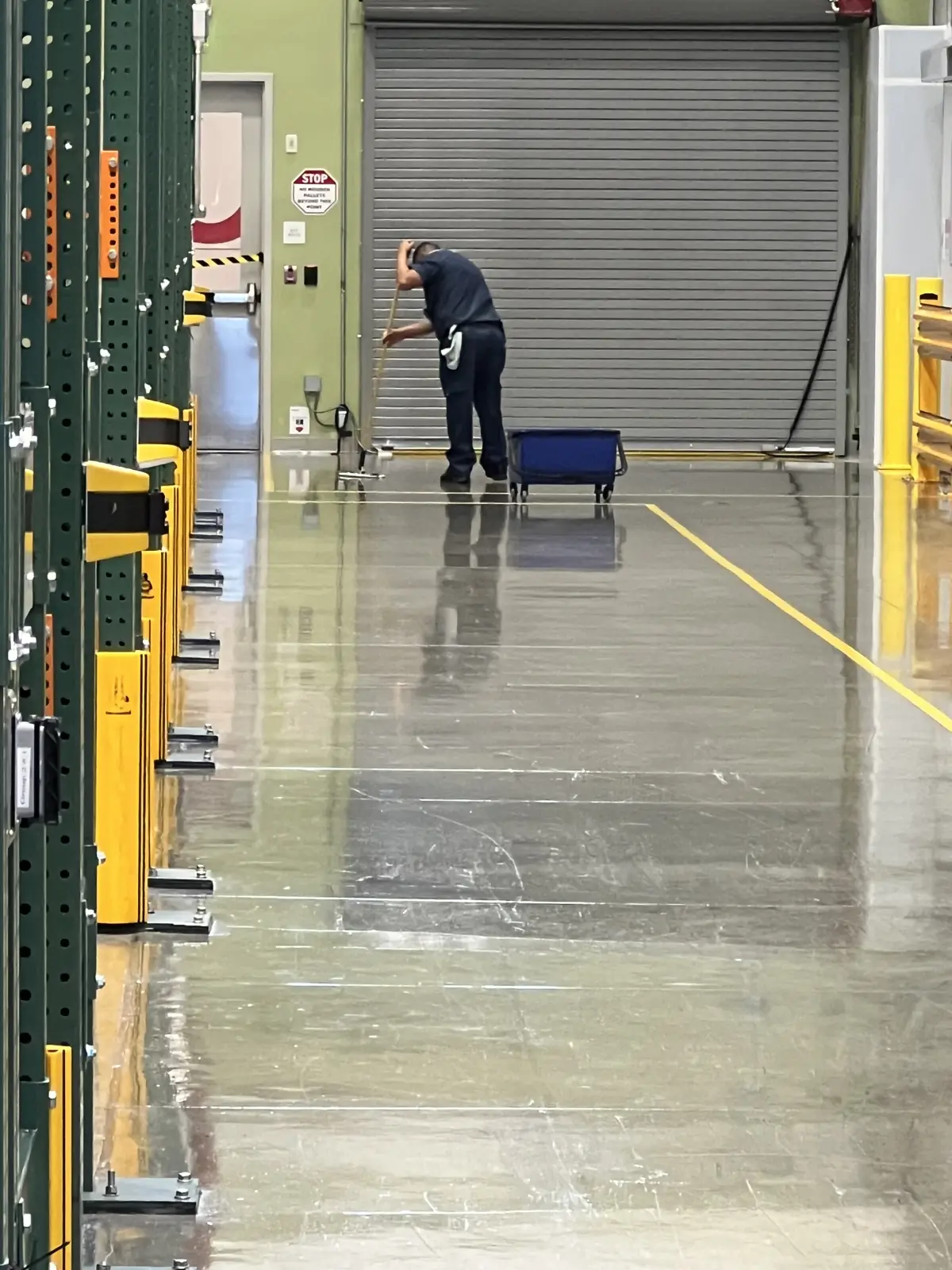
For manufacturing and warehouse accounts, the program is built around production shifts rather than a fixed nightly window, so cleaning happens during planned downtime instead of competing with output.
Night cleaning or day porter coverage — which does a facility need?
Night cleaning resets the building after hours; day porter coverage keeps restrooms stocked, spills handled and common areas presentable while people are actually using the space. Most facilities with regular foot traffic need both — night cleaning for the deep reset, a porter for the hours in between.
- Night or off-shift cleaning: full restroom sanitation, trash, floor maintenance, detail work
- Day porter coverage: restocking, spot response, lobby and entry upkeep during operating hours
- Facilities that run second and third shifts often need cleaning windows built around production breaks rather than a single overnight block
See day porter services for how that daytime layer is scoped separately from the recurring janitorial contract, and where the two are combined into a single program.
How is a janitorial scope of work put together?
A scope of work lists every space, its cleaning frequency, the tasks performed at each visit, and the standard used to judge whether the work was done. Nexara writes this before staffing a single hour, so the facility manager has a document to measure against rather than a verbal understanding.
- 01
Walkthrough
The owner walks the facility, room by room, to understand traffic, sensitivity and existing pain points.
- 02
Space breakdown
Every space is categorized by type and assigned a frequency — daily, nightly, weekly or scheduled around production.
- 03
Task list per visit
Each frequency gets a defined task list, so 'clean the restroom' becomes a specific, repeatable checklist.
- 04
Inspection standard
A documented standard defines what 'done' looks like, so quality is measured against the scope, not opinion.
- 05
Escalation path
A single point of contact is named for when something is missed, and the response window is written into the scope.
A written scope of work template is useful even outside a Nexara contract — see the janitorial scope of work template guide for a breakdown any facility manager can use to evaluate a current provider.
What consumables does a janitorial program cover?
Restroom and break-room consumables — toilet tissue, hand soap, paper towels, hand sanitizer and liner stock — are managed as part of the recurring program, with usage tracked so restocking happens on a schedule rather than after someone runs out. Which items are included and which are billed separately is defined in the scope.
Running out of restroom supplies mid-shift is a visible failure that reflects on the whole program, even when the rest of the building is clean. Consumables management is scheduled restocking tied to usage patterns at each site, not a reactive response to complaints.
- Restroom paper products, soap and sanitizer, tracked by usage rate per site
- Trash liners sized and stocked to the receptacles actually in use
- Break room supplies where the scope includes kitchen and pantry areas
How do floor and carpet maintenance fit into a recurring program?
Hard-floor and carpet maintenance are built into the recurring janitorial schedule rather than sold as separate emergency calls — routine scrubbing, vacuuming and spot response happen on the nightly or weekly cycle, while deep-cycle work like stripping or extraction is scheduled quarterly or as the floor condition requires.
See floor care for strip, refinish and burnish cycles, and carpet cleaning for extraction and encapsulation frequencies. Both are typically written into the same scope of work as the recurring janitorial contract rather than billed as one-off projects, so the facility isn't re-negotiating every time a floor needs attention.
How does quality inspection and accountability work?
Every Nexara account is measured against the documented inspection standard written into its scope, with a named point of contact and a response window written into that scope for when something is missed. Accountability means the facility manager reaches the owner directly, not a call center or a rotating account rep.
For facilities weighing a new provider against a current one, how to choose a commercial cleaning company lays out the questions that separate a program from a labor-only contract.
What facility managers ask us.
What's the difference between janitorial services and day porter services?
Janitorial service is the recurring, scheduled cleaning of a facility — usually nightly or off-shift — covering restrooms, floors, trash and common areas. A day porter is on site during operating hours handling restocking, spills and lobby upkeep between those scheduled cleanings. Facilities with steady daytime traffic often run both.
Can a janitorial program be scheduled around production shifts?
Yes. Manufacturing and distribution accounts are commonly cleaned during second or third shift, planned downtime, or weekends, so the program doesn't compete with production. The schedule is built around the facility's operation rather than a fixed nightly template.
What happens when something is missed during a cleaning visit?
Every account has a named point of contact and a documented inspection standard it's measured against. When a task is missed, the facility manager reports it to that contact, and the response window is the one written into the scope — not a ticket routed through a call center.
Do I need a written scope of work, or is a verbal understanding enough?
A written scope is what protects both sides. Without one, 'clean the restroom' means different things to different people, and there's nothing to measure a missed task against. Nexara writes the scope before service starts, covering frequencies, tasks and the inspection standard. Commercial and office buildings and plants use the same structure with different task lists.
Are supplies and consumables included in a janitorial contract?
Consumables are defined in the scope. Restroom paper products, soap and liners are commonly included and restocked on a usage-based schedule; some contracts bill consumables separately. Which applies is defined in writing before service starts, so there's no ambiguity at invoice time.
How often is floor and carpet care included in a janitorial program?
Routine floor and carpet upkeep — daily vacuuming, spot response, scrubbing — runs on the same nightly schedule as the rest of the program. Deep-cycle work such as stripping, refinishing or hot water extraction is scheduled quarterly or based on floor condition, and is written into the same scope. See floor care and carpet cleaning.
Can a janitorial program cover a school or GMP facility?
Yes, but the scope changes. K-12 facilities need cleaning scheduled around the academic calendar and student presence, while GMP and regulated facilities need documented, repeatable procedures that match the facility's own compliance requirements.
What areas does Nexara serve for recurring janitorial contracts?
Recurring janitorial is where being close matters most, because the program runs every night. Nexara is based in Ontario and covers Rancho Cucamonga, Riverside, Upland and Fontana directly. Recurring contracts elsewhere in San Bernardino County and the other four counties are scoped case by case.
Reviewed by Nexara Facility Services · Updated
Our crews, on site.
Other services.
- Floor Care & Hard Surface MaintenanceFloor Care
- Concrete & Natural Stone PolishingStone Polishing
- Commercial Carpet CleaningCarpet Cleaning
- Commercial Window CleaningWindow Cleaning
- Pressure Washing & Exterior CleaningPressure Washing
- Day Porter ServicesDay Porter
- High DustingHigh Dusting
- Parking Lot SweepingLot Sweeping
- Post-Construction CleanupConstruction Cleanup
No proposal before a walkthrough
Let's walk your facility.
Every scope starts with a walkthrough. We look at the building, ask what is actually going wrong today, and come back with a written scope and a number — not a brochure.