
Published · 4 min read
You clean a facility that never shuts down by splitting it into zones and giving each zone its own cleaning window, set by when that area is quietest. Shared spaces like restrooms and break rooms get touched on every shift, production and warehouse floors rotate through the lightest shift, and heavy floor work waits for planned downtime. The building never empties, so the schedule has to stop assuming it will.
Most janitorial programs assume a building that goes dark at 6 p.m. A plant running three shifts breaks that model: the crew shows up, the forklifts are still moving, and nobody told them which aisle they can have.
Why doesn't a normal night schedule work?
A night schedule assumes the crew can walk in and have the whole building. In a 24/7 operation, third shift is still production. The crew ends up cleaning around people, skipping areas that are busy, and doing the same easy spaces every night because those are the ones that happen to be open.
What gets skipped is usually what matters most: the dock area, the busy aisles and the restrooms closest to the floor. Those see the most traffic on every shift, so they are never empty when the crew arrives.
How should you split the building into zones?
Start with how the building is actually used, not the floor plan. We typically walk a site with the operations lead and sort every area into three groups:
- Shared spaces used on every shift: restrooms, break rooms, locker rooms, entries. These need service on every shift, not once a day.
- Production and warehouse floors: aisles, pick zones, staging, docks. These rotate on a set schedule during the lightest shift or a known lull.
- Offices and low-traffic rooms: front offices, conference rooms, training rooms. These often keep a normal evening schedule because they really are empty at night.
Each zone gets a frequency, a time window and an owner. "Dock area, sweep and spot scrub, Tuesday and Friday, 2 a.m. to 4 a.m., third-shift crew" is a scope line someone can follow. "Clean warehouse nightly" is not.
When are the best cleaning windows in a 24/7 operation?
Every site is different, but the same few windows show up again and again:
- The lightest shift. Most 24/7 sites have one shift with fewer people and less equipment running. That is where rotating floor work belongs.
- Shift changes. Break rooms and restrooms empty for a short stretch right after a changeover. A crew timed to hit them gets far more done.
- Production lulls. Line changeovers, scheduled maintenance and slow inbound days open up floor space. If the crew knows about them in advance, they can use them.
- Planned shutdowns. Holiday weekends and maintenance shutdowns are where strip-and-recoat, deep scrubbing and high dusting over equipment get scheduled.
The key is a standing conversation with the shift leads. A five-minute check-in at the start of the cleaning shift tells the crew which zones are open tonight and which ones to leave alone.
Who covers the shared spaces on every shift?
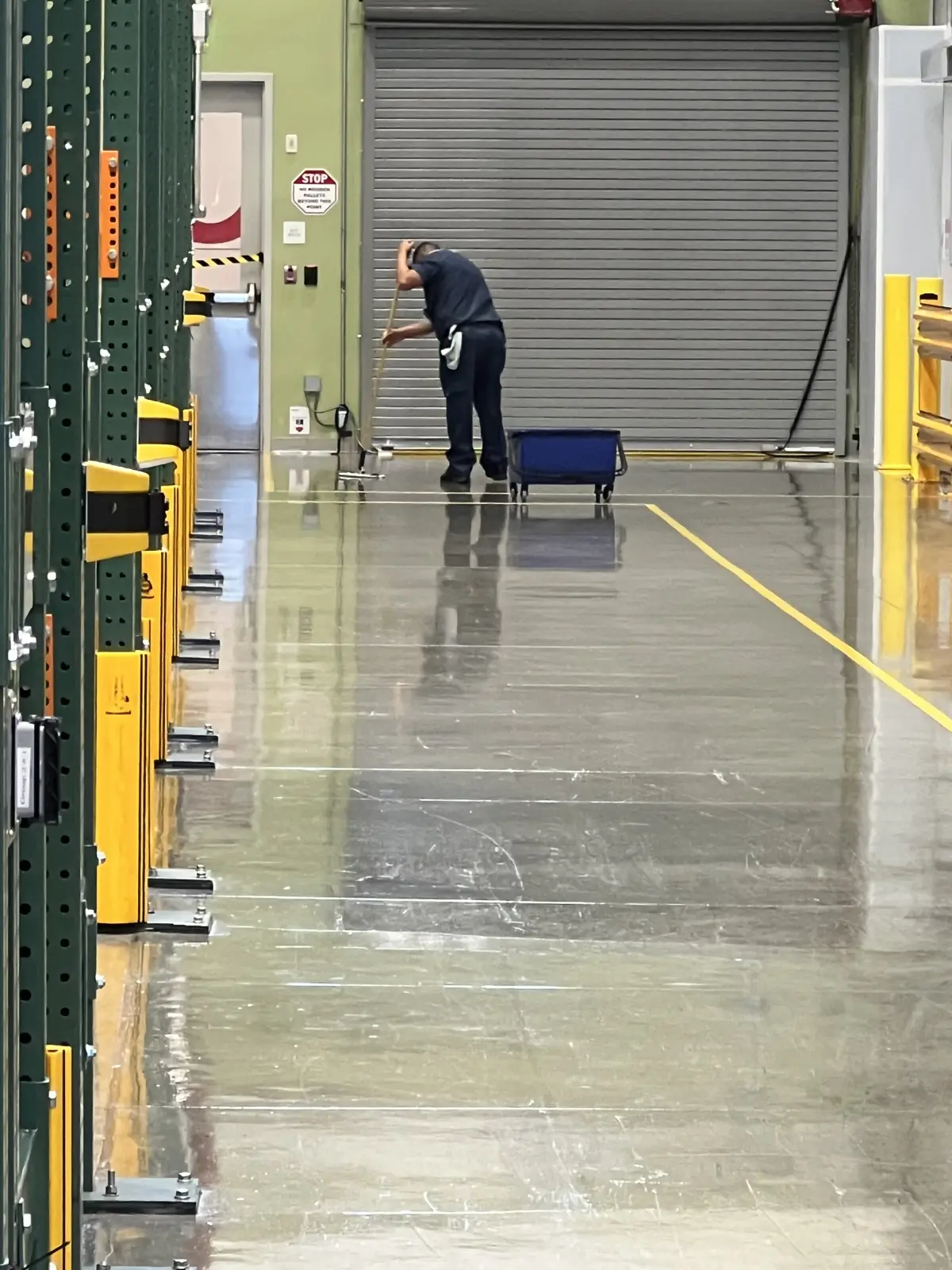
A restroom serviced at 2 a.m. is in rough shape by noon if a full day shift has used it since. That is why most around-the-clock sites add day porter coverage on the busiest shifts, with a dedicated cleaning crew on the lightest one. The porter handles restroom checks and restocking, break room resets, trash runs and spills. The crew does the scheduled, heavier work.
If you are deciding how to split the hours, our day porter vs. night janitorial guide walks through what each one is good at.
How do you keep cleaning safe around live operations?
Cleaning on an active floor puts people with mops and machines in the same space as forklifts and pallet jacks. A few rules carry most of the weight:
- Barricade the work area. Cones and signs around every wet or machine-cleaned section, set before the work starts.
- Work with the floor, not against it. The crew follows the site's traffic rules, pedestrian walkways and dock procedures, the same as any employee.
- Keep floors dry behind you. OSHA's walking-working surfaces rule requires floors to be kept clean and, as far as possible, dry (29 CFR 1910.22). On a live floor that means smaller sections, less water and a squeegee or scrubber pickup instead of leaving an aisle to air dry.
- Never park equipment in an aisle or exit path. Carts and scrubbers stay out of traffic lanes when not in use.
How do you handle floor care without a shutdown?
Routine floor care works fine on a rotation. Auto-scrubbing and burnishing can be done one aisle or zone at a time, with the shift lead closing that section for the length of the pass. Most sites cycle through the whole floor over a week or two rather than trying to do it all in one night.
Full strip-and-recoat is different. It needs an area closed long enough for the finish to cure, so it belongs on the shutdown calendar. Get those dates from operations early in the year so the work is planned, not squeezed in.
Where Nexara fits
We build zone-based cleaning schedules for manufacturing and warehouse facilities across the Inland Empire and Southern California, including sites that never close. If your crew keeps working around the same busy areas, request a walkthrough.
Questions we get asked.
When should a 24/7 facility be cleaned?
In zones, on a rotation, during the lightest shift and around shift changes. Instead of one nightly window for the whole building, each area gets its own window based on when it is least busy.
Do you need a day porter in a facility that runs around the clock?
Most do. Restrooms, break rooms and spills need attention on every shift, so many 24/7 sites have porter coverage on the busiest shifts and a dedicated cleaning crew during the lightest one.
How do you do floor care if the floor never empties?
Work it in sections. Scrub or burnish one aisle or zone at a time with cones and barricades, coordinated with the shift lead, and save full strip-and-recoat work for planned shutdowns or holiday weekends.