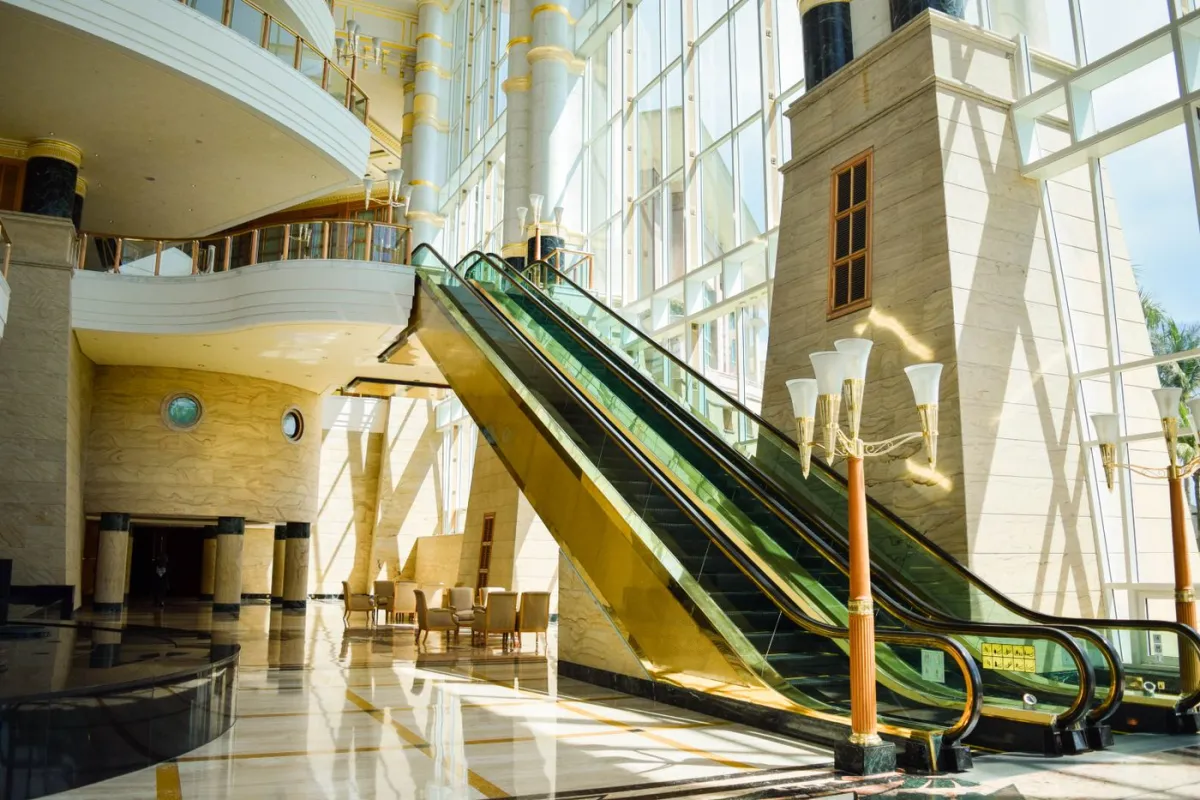

Day porter and night janitorial solve different problems — here's what each actually covers and how to decide which combination your facility needs.
What does a day porter cover that a night crew doesn't?
A day porter works while the building is occupied, responding in real time to spills, restroom depletion, trash overflow and lobby appearance — the visible, moment-to-moment upkeep a night crew can't provide because they're not there during business hours.
Day porter services are built around presence and response, not a fixed checklist completed once. A porter's round covers restroom checks and restocking before supplies run out, immediate spill response before it becomes a slip hazard, lobby and elevator upkeep, and trash/recycling removal during the hours people are actually generating it. The value is timing: a restroom that's fine at 8 a.m. can be out of paper towels by 11, and only someone on-site catches that.
- Restroom checks and restocking on a set round, not a single morning pass
- Spill response and immediate cleanup before it becomes a slip hazard
- Lobby, entry, elevator and common-area upkeep between scheduled cleans
- Trash and recycling removal during the hours people are actually generating it
- Break room, kitchen and conference room resets between meetings
- A visible, identifiable presence that itself signals the building is maintained
What does night janitorial cover that a day porter doesn't?
Night janitorial handles the systematic, disruptive, or equipment-heavy work that needs an empty building — full floor care, detailed restroom sanitation, complete trash pulls, and the kind of thorough clean that resets every space for the next day.
Night crews complete the tasks a porter round can't fit around active foot traffic: auto-scrubbing floors, vacuuming every space rather than just high-visibility ones, full restroom disinfection rather than spot checks, dusting and detail work in unoccupied offices, and the deeper janitorial scope that requires moving furniture, running equipment, or working through areas that need to be empty to clean properly. Night cleaning is what makes the building start each day at a reset baseline; day porter coverage is what keeps it from degrading visibly before the next reset.
- Auto-scrubbing and detail floor work that needs an empty aisle or corridor
- Full restroom disinfection, not just a mid-day check and restock
- Complete trash and recycling pulls from every space, not just high-traffic bins
- Dusting, detail cleaning and floor care tasks that require moving furniture or equipment
- Vacuuming and carpet maintenance across the entire footprint rather than visible areas only
Some of the specialized work that both crews eventually feed into — carpet cleaning, window cleaning, or a floor stripping cycle — sits on its own schedule outside either daily coverage, since it needs more time and different equipment than a nightly round allows.
Why do some facilities need both day porter and night janitorial coverage?
Buildings with continuous occupancy, high public visibility, or operations that never fully stop need both: night crews handle the systematic deep clean, and a day porter prevents the building from visibly declining in the hours between resets.
- Multi-tenant office and medical buildings: tenants and visitors are present all day; a lobby or restroom that degrades by mid-afternoon reflects on property management, not just the cleaning contractor.
- Manufacturing plants with daytime shifts: production doesn't stop for cleaning, so spill response and restroom upkeep during the shift matter as much as the full clean afterward.
- K-12 schools during the school day: hundreds of daily restroom uses and cafeteria turnover need daytime response; the deep clean still happens on the custodial night or summer schedule.
- Retail and hospitality: customer-facing spaces can't wait until closing for a spill or an empty paper towel dispenser to get fixed.
The test isn't building size — a small medical suite with constant patient flow can need daytime coverage more urgently than a large but lightly trafficked warehouse office. The relevant question is how many people move through the space each day, how visible the common areas are to those people, and how quickly a lapse (an empty soap dispenser, an unaddressed spill, an overflowing bin) becomes a complaint or a liability rather than a minor inconvenience that waits until the next scheduled clean.
How do facilities typically schedule the two together?
Most hybrid programs run a night crew for the full systematic clean after close, and a day porter on a fixed round (or a fluid, needs-based patrol) during occupied hours, coordinated through one scope document so nothing gets duplicated or missed between shifts.
Common scheduling patterns
Night-only
- How it works
- Full clean after close; no daytime coverage
- Best fit
- Low-traffic offices, closed-to-public facilities
Day porter + night crew (hybrid)
- How it works
- Porter handles daytime response; night crew handles the systematic deep clean
- Best fit
- Multi-tenant, medical, continuous-occupancy buildings
Day porter only
- How it works
- No after-hours access or need; porter handles both response and light cleaning during the day
- Best fit
- Smaller facilities, tenant-improvement or construction-adjacent sites with limited after-hours access
Second/third shift instead of after-close
- How it works
- Cleaning scheduled during production downtime rather than a fixed "night" window
- Best fit
- Manufacturing and distribution running multiple shifts
| Model | How it works | Best fit |
|---|---|---|
| Night-only | Full clean after close; no daytime coverage | Low-traffic offices, closed-to-public facilities |
| Day porter + night crew (hybrid) | Porter handles daytime response; night crew handles the systematic deep clean | Multi-tenant, medical, continuous-occupancy buildings |
| Day porter only | No after-hours access or need; porter handles both response and light cleaning during the day | Smaller facilities, tenant-improvement or construction-adjacent sites with limited after-hours access |
| Second/third shift instead of after-close | Cleaning scheduled during production downtime rather than a fixed "night" window | Manufacturing and distribution running multiple shifts |
Day cleaning also has an energy argument that is separate from porter coverage. BOMA International includes day cleaning in its list of top ten low- and no-cost energy strategies, with the reasoning that janitors can clean while the lights are already on instead of keeping lights and HVAC running for an after-hours crew. It's one reason some buildings move part of the cleaning scope into the day rather than assuming everything belongs after close.
How does a facility set the staffing level for a day porter?
Porter staffing is sized to restroom count, common-area square footage, and how many people move through the building each day — not to a generic per-square-foot rule — so the round can actually be completed before it needs to start again.
A porter round that takes 90 minutes to complete on a building with 200 daily visitors will fall behind on a building with 1,200. Sizing the role correctly means walking the actual restroom count, common-area footprint, and daily foot traffic pattern before setting hours — a written scope should state exactly what areas the porter covers, how often each is checked, and what escalates to a supervisor versus getting handled on the spot.
The same principle applies on the night side: a night crew sized for the wrong square footage either rushes the job or runs into unplanned overtime. Both roles work from the same underlying scope document so nothing falls into a gap between the two shifts — a well-defined janitorial scope of work names which shift owns which task, area by area.
Which coverage does your facility actually need?
The decision comes down to occupancy pattern and visibility: continuously occupied, publicly visible, or high-restroom-traffic buildings generally need day porter coverage in addition to night janitorial, while single-shift, low-traffic, closed-to-public spaces can usually run on a night-only program without a daytime gap showing.
Coverage decision guide
Public-facing lobby or storefront, open all day
- Coverage need
- Day porter + night janitorial
Single-shift office, closed evenings and weekends
- Coverage need
- Night janitorial only, typically sufficient
24/7 or multi-shift production
- Coverage need
- Shift-aware janitorial scheduled around production; porter-style coverage during active shifts
School campus during the academic year
- Coverage need
- Day porter/custodial presence during school hours; deep clean nights, weekends and breaks
Medical or lab building with continuous patient/staff presence
- Coverage need
- Day porter + night janitorial, often with restroom and high-touch focus built into both
| Facility characteristic | Coverage need |
|---|---|
| Public-facing lobby or storefront, open all day | Day porter + night janitorial |
| Single-shift office, closed evenings and weekends | Night janitorial only, typically sufficient |
| 24/7 or multi-shift production | Shift-aware janitorial scheduled around production; porter-style coverage during active shifts |
| School campus during the academic year | Day porter/custodial presence during school hours; deep clean nights, weekends and breaks |
| Medical or lab building with continuous patient/staff presence | Day porter + night janitorial, often with restroom and high-touch focus built into both |
Common questions.
Is a day porter the same as a receptionist or front-desk staff?
No. A day porter's role is facility upkeep — restrooms, common areas, trash, spills — not answering phones or greeting visitors, though a visible, identifiable porter does add a positive presence in a lobby. Some contracts add limited point-of-contact duties for tenants, but that's an addition to the cleaning scope, not the core of it.
Can a day porter handle a spill or a mess an employee reports mid-day?
That's the core value of the role: response during business hours rather than waiting for the next scheduled night visit. A porter already on site can be sent to a spill, a restroom issue, or a common-area mess as soon as it's reported, instead of it sitting until evening.
Does a day porter replace the need for occasional deep cleaning?
No. A day porter maintains between deep cleans; it doesn't replace floor care, full restroom sanitation, or detailed cleaning that needs an unoccupied space or specialized equipment. Those stay on the night or scheduled program.
How many hours a day does a typical day porter work?
This varies by facility size, traffic and budget — some buildings need a porter present for a full business day, others need coverage only during peak hours. The right hours depend on when your building's foot traffic and restroom/common-area demand actually occur.
Do manufacturing plants need day porters if they already have night janitorial?
Often, yes, because production runs during the day and spills, restroom demand and break-room turnover happen on that same schedule. See manufacturing and warehouse. A night-only program means those issues sit unaddressed for a full shift.
Can day porter coverage be added later if we start with night-only?
Yes. It's common to start with a night program and add day porter coverage once a specific gap becomes visible — a lobby that looks worn by afternoon, restroom complaints, or a tenant escalation. The scope can expand without restructuring the existing night contract.
What happens during a school day if a spill or restroom issue occurs between scheduled cleanings?
That's precisely the daytime coverage gap a porter or custodial presence during the school day is meant to close — a bathroom running out of supplies or a hallway spill can't wait for the after-hours custodial shift without becoming a safety or complaint issue.
Is day cleaning less thorough than night cleaning because people are still in the building?
Day cleaning tasks are chosen specifically because they can be done around occupants — restocking, spot response, common-area upkeep — while tasks that need an empty space (full floor auto-scrubbing, moving furniture, detailed restroom disinfection) stay on the after-hours schedule. It's a division of labor, not a lower standard.
Does combining day porter and night janitorial cost more than either alone?
Combining coverage adds hours, so it costs more than a single-shift program — but the comparison depends on your building's size and needs, which we can't generalize here. See commercial cleaning cost in the Inland Empire for how to think about that comparison.
What should be written into the scope so day porter and night janitorial don't overlap or leave gaps?
Name every area, assign it to a shift, and state the frequency and standard for each — restrooms checked by the porter at set intervals and disinfected in full at night, for example. A written scope removes the ambiguity that causes either duplicated effort or an unowned task. See how to choose a commercial cleaning company for what else that scope should define.
Reviewed by Nexara Facility Services · Updated