Cleaning, sanitizing and disinfecting are distinct, regulated steps with different chemistry and timing — here's what CDC, EPA and OSHA actually require of each.
What's the difference between cleaning, sanitizing and disinfecting?
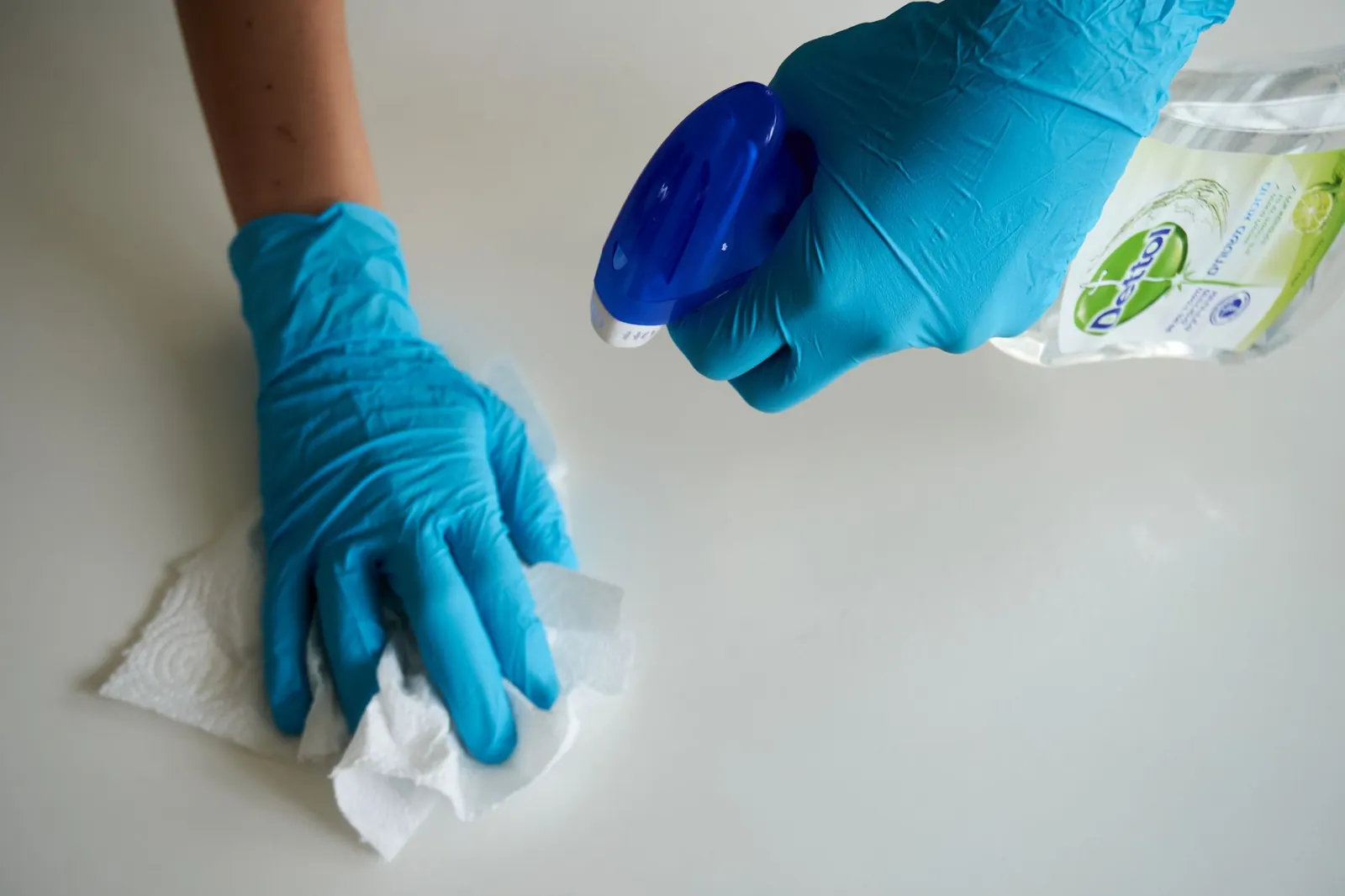
The CDC describes cleaning as removing germs, dirt and impurities with soap, water and scrubbing; sanitizing as reducing germs to levels public health codes or regulations consider safe; and disinfecting as using chemicals that kill remaining germs on surfaces. Each is a distinct step, not interchangeable words for the same task.
CDC definitions and how each step works
Cleaning
- What it does
- Removes dirt, germs and impurities from a surface
- How it's done
- Soap or detergent, water, and physical scrubbing
- CDC guidance on timing
- Regularly on high-touch surfaces; whenever visibly soiled
Sanitizing
- What it does
- Reduces germs to levels public health codes or regulations consider safe
- How it's done
- Weaker bleach solutions or sanitizing sprays
- CDC guidance on timing
- After cleaning; common on food-contact surfaces and where a code sets a safe level
Disinfecting
- What it does
- Kills the germs that remain after cleaning
- How it's done
- EPA-registered disinfectant, kept wet for the label's contact time
- CDC guidance on timing
- When someone is sick or at higher risk of getting sick, and as an option in high-traffic areas — not a default step for every surface
| Term | What it does | How it's done | CDC guidance on timing |
|---|---|---|---|
| Cleaning | Removes dirt, germs and impurities from a surface | Soap or detergent, water, and physical scrubbing | Regularly on high-touch surfaces; whenever visibly soiled |
| Sanitizing | Reduces germs to levels public health codes or regulations consider safe | Weaker bleach solutions or sanitizing sprays | After cleaning; common on food-contact surfaces and where a code sets a safe level |
| Disinfecting | Kills the germs that remain after cleaning | EPA-registered disinfectant, kept wet for the label's contact time | When someone is sick or at higher risk of getting sick, and as an option in high-traffic areas — not a default step for every surface |
The CDC tells facilities to clean surfaces before disinfecting them, because dirt and impurities can keep a chemical product from working, and EPA's six-step guide says to pre-clean a visibly dirty surface with soap and water. Skipping straight to a disinfectant on a dirty surface undermines the product's own label claims.
Why does it matter whether a product is EPA-registered?
EPA regulates disinfectants as pesticides — under federal pesticide law (FIFRA) — and approves the label language, verifying that a registered disinfectant works according to its label directions. If a label doesn't include directions for a given pathogen, EPA hasn't reviewed data on the product's use against it.
Every EPA-registered disinfectant carries an EPA Registration Number on its label, in two or three parts separated by dashes. The first two parts are the primary registration; a third part identifies a supplemental distributor selling the same formulation under another name. EPA says the registration number is the only way to accurately identify a product — not the marketing copy on the bottle.
Sanitizer and disinfectant are different label claims, not two names for one product. Each registered label lists the microorganisms the product is effective against and the directions for each use. A product labeled only as a sanitizer hasn't been approved for disinfecting claims, which is why the two aren't interchangeable even when both carry an EPA registration number.
What is EPA's List N, and why does dwell time matter?
List N is EPA's list of disinfectants it expects to kill all strains and variants of SARS-CoV-2 when used according to label directions. Dwell time, also called contact time, is how long the surface has to stay wet with the product; EPA's guidance says the surface should remain wet the whole time for the product to be effective.
To check a product, EPA says to find the EPA Reg. No. on the label and enter its first two parts into the List N tool; a three-part number with the same first two parts is an equivalent distributor product. Being on the list doesn't mean the product works however it's applied: EPA's six-step guide says to follow the contact time and keep the surface wet the whole time.
When does a facility actually need sanitizing or disinfecting, versus just cleaning?
Routine cleaning is sufficient for most surfaces most of the time; sanitizing is standard where a safety code sets a bacterial-safety threshold, such as food-contact surfaces; disinfecting is reserved for high-touch surfaces, restroom fixtures, healthcare-adjacent spaces, and situations with elevated infection risk.
- Restroom fixtures and high-touch surfaces (door handles, stair rails, elevator buttons, touchpads): CDC's facility guidance lists these as high-touch surfaces and says high-traffic spaces may warrant more frequent cleaning or disinfection in addition to cleaning, because they're touched by many people between cleanings — the kind of daily attention a day porter round is built to catch between full night cleans.
- Food-contact surfaces: these fall under food-code sanitizing requirements, not general disinfecting — the standard is a bacterial-safety level appropriate for surfaces that touch food, achieved through a defined sanitizer concentration and contact time.
- General office and common-area surfaces: CDC guidance is that in most situations cleaning regularly is enough to prevent the spread of germs, with disinfection called for when someone is sick or at higher risk rather than as a blanket daily default.
- Healthcare and healthcare-adjacent facilities: CDC's environmental infection control recommendations call for cleaning and disinfecting high-touch surfaces on a more frequent schedule than minimal-touch housekeeping surfaces such as floors and walls, similar to how life sciences and laboratories zone cleaning by area classification.
This is standard janitorial services territory, and in schools it sits alongside district rules — see K-12 and education. The chemistry decision belongs in the written scope, not left to whoever happens to be cleaning that area that day.
What does OSHA's Hazard Communication Standard require for the chemicals used to do this work?
OSHA's Hazard Communication Standard, 29 CFR 1910.1200, requires employers to keep a safety data sheet in the workplace for each hazardous chemical they use — cleaning, sanitizing and disinfecting products included — to keep containers labeled, and to train employees on those hazards at initial assignment and when a new hazard is introduced.
The Hazard Communication Standard exists so that anyone using a chemical, or working around it, knows what it is and how to handle it safely. For a facility that brings in outside cleaning chemistry — its own or a contractor's — that means three things have to be in place: a Safety Data Sheet (SDS) for every hazardous product in use, labeled containers, and training for employees who work with those chemicals, delivered at initial assignment and again whenever a new chemical hazard is introduced to their work area.
This applies directly to disinfectants and sanitizers, most of which are hazardous chemicals under the standard's classification criteria even when EPA-registered for antimicrobial use — EPA registration and OSHA's Hazard Communication requirements are separate, both-apply obligations, not substitutes for each other.
How should a facility set the right level for each area, rather than guessing?
A written scope should assign a cleaning, sanitizing, or disinfecting standard to each area type based on its actual risk profile — restrooms and food areas get a higher standard than general office space — rather than applying one blanket chemical routine building-wide.
Matching the standard to the area
General office, corridors, conference rooms
- Typical standard
- Cleaning; disinfecting where someone has been sick
- Why
- CDC: in most situations, cleaning regularly is enough
Restrooms and high-touch fixtures
- Typical standard
- Cleaning plus disinfecting on a schedule set in the scope
- Why
- CDC lists restroom fixtures and door handles as high-touch surfaces
Food prep or food-contact surfaces
- Typical standard
- Cleaning plus sanitizing to code
- Why
- Food-contact surfaces are governed by a defined bacterial-safety threshold, not a general disinfecting standard
Healthcare-adjacent and lab support spaces
- Typical standard
- Cleaning plus disinfecting on a defined schedule
- Why
- CDC healthcare guidance: high-touch surfaces on a more frequent schedule than floors and walls
| Area type | Typical standard | Why |
|---|---|---|
| General office, corridors, conference rooms | Cleaning; disinfecting where someone has been sick | CDC: in most situations, cleaning regularly is enough |
| Restrooms and high-touch fixtures | Cleaning plus disinfecting on a schedule set in the scope | CDC lists restroom fixtures and door handles as high-touch surfaces |
| Food prep or food-contact surfaces | Cleaning plus sanitizing to code | Food-contact surfaces are governed by a defined bacterial-safety threshold, not a general disinfecting standard |
| Healthcare-adjacent and lab support spaces | Cleaning plus disinfecting on a defined schedule | CDC healthcare guidance: high-touch surfaces on a more frequent schedule than floors and walls |
This is the kind of area-by-area standard a written janitorial scope of work should document explicitly — naming which areas get sanitized, which get disinfected, with what product, and on what frequency — rather than leaving the chemistry decision to whoever is cleaning that day.
Common questions.
Is bleach a disinfectant or a sanitizer?
It can function as either, depending on dilution and contact time — a weaker bleach solution is commonly used for sanitizing, while a stronger solution and longer contact time is used for disinfecting. The specific product label and its EPA registration determine which claim applies at which concentration; don't assume one dilution serves both purposes interchangeably.
Do I need to disinfect every day, or is cleaning enough most days?
For most general spaces, CDC guidance is that cleaning regularly is enough in most situations, and to disinfect when someone is sick or at higher risk. High-traffic, high-touch surfaces and restrooms are where CDC says you may choose to clean more often or disinfect in addition — a choice to write into the scope.
What does an EPA registration number actually guarantee?
It confirms EPA has registered the product as a pesticide and approved the label language describing what it is effective against and how to use it. It does not guarantee the product works if used off-label — diluted incorrectly, applied for less than the stated contact time, or used on a surface type the label doesn't cover.
Can a green or 'natural' cleaning product also be a registered disinfectant?
Yes, if it carries an EPA registration and label claims to that effect — 'green' or 'natural' marketing language is not itself an antimicrobial claim and doesn't substitute for registration. Check the label for a registration number rather than relying on the front-of-bottle branding.
Why does a disinfectant need to stay wet for a full contact time to work?
The kill claim on the label was established through testing at a specific contact time — the manufacturer measured how long the active ingredient needs to remain in contact with the pathogen to achieve the stated reduction. Wiping it dry early cuts that exposure short and the surface may not actually be disinfected even though the product was applied.
Are OSHA's Hazard Communication requirements only for large chemical users, or do they apply to a small facility's cleaning supplies too?
They apply based on whether hazardous chemicals are present in the workplace, not the size of the operation. A small office storing a few bottles of disinfectant and glass cleaner still needs SDS access, compliant labels, and basic employee training if those products meet the standard's hazard classification criteria.
What's the difference between a 'broad-spectrum' disinfectant and a regular one?
The label's efficacy claims list the specific organisms the product has been tested and registered against. A broader label lists more pathogen types (bacteria, a range of viruses, fungi); a narrower one may only claim effectiveness against specific bacteria. Match the product to the pathogens actually relevant to that space rather than assuming any registered disinfectant covers everything.
Does sanitizing food-contact surfaces require a specific EPA-registered product, or will any cleaner work?
Food-contact surface sanitizing is governed by food-safety code requirements for a defined level of bacterial reduction, which means the sanitizer used has to be labeled and registered for food-contact use at the correct concentration — a general-purpose cleaner or a disinfectant not labeled for food-contact surfaces doesn't meet that standard.
Should restrooms be disinfected on every visit or on a set schedule?
CDC lists restroom fixtures among high-touch surfaces, and its healthcare guidance calls for high-touch surfaces to be cleaned and disinfected more often than minimal-touch ones. The right frequency depends on traffic volume and the facility's own risk tolerance, documented in the cleaning scope rather than decided ad hoc.
- CDC — Cleaning and Disinfecting
- CDC — When and How to Clean and Disinfect a Facility
- U.S. EPA — Selected EPA-Registered Disinfectants (registration numbers, FIFRA framework)
- U.S. EPA — About List N: Disinfectants for Coronavirus (COVID-19)
- U.S. EPA — 6 Steps for Safe & Effective Disinfectant Use (pre-clean; keep wet for contact time)
- OSHA — Hazard Communication overview
- Cornell Law School LII — 29 CFR 1910.1200, Hazard communication (SDS in (g)(1), training in (h)(1))
- CDC — Part II, Recommendations for Environmental Infection Control in Health-Care Facilities
Reviewed by Nexara Facility Services · Updated