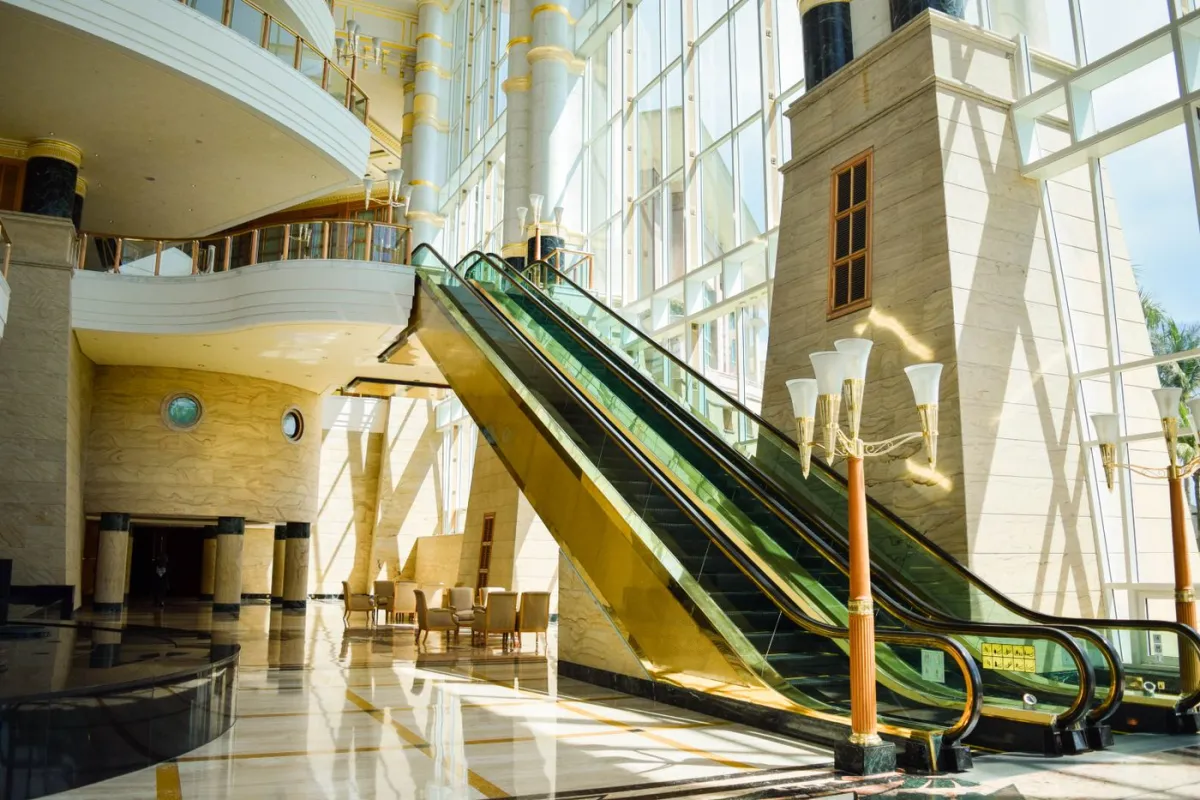
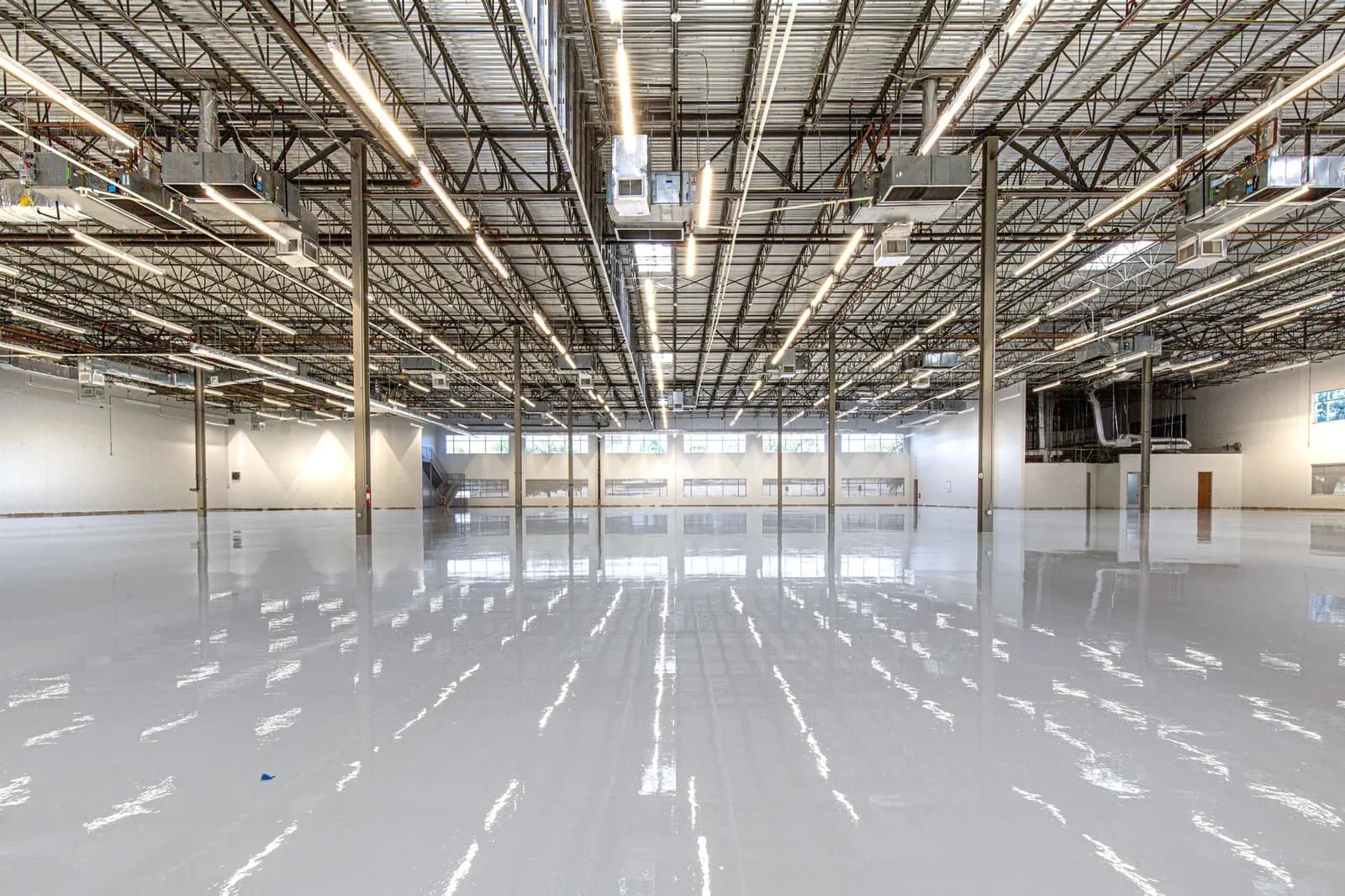
Polished concrete and epoxy solve the same warehouse-floor problem in opposite ways — here's how they actually compare under forklift traffic.
What's the actual difference between polished concrete and an epoxy coating?
Polished concrete mechanically refines the existing slab with progressively finer diamond abrasives until the aggregate and cream reach a specified gloss — the shine comes from the concrete itself. An epoxy coating applies a resin layer on top of the slab; the shine and color come from the coating, not the substrate underneath.
The Concrete Polishing Council, a specialty council of the American Society of Concrete Contractors (ASCC), publishes the industry's specifications, guidelines and position statements, including a position statement on slip resistance of polished concrete. The owner-facing specification is ACI 310.1-20, Specification for Polished Concrete Slab Finishes.
Epoxy is a different category of product entirely. It's a two-part resin system that cures into a hard film bonded to the slab surface. Because it sits on top rather than becoming part of the slab, it can be pigmented, textured with broadcast aggregate for traction, and built up to a specified thickness in a way bare polished concrete cannot.
Both processes fall under the same stone and concrete polishing and floor care umbrella that a facility manager should evaluate together with the rest of a hard-floor program — neither decision happens in isolation from the building's broader maintenance schedule.
How is each floor installed, and what does the slab need to be ready?
Polished concrete is ground in progressive steps directly on cured, sufficiently dry slab, with the slab's own moisture and quality governing the outcome. Epoxy requires slab prep (grinding or shot-blasting for mechanical bond), a moisture check, and a controlled cure window before coating.
- 01
Polished concrete — grinding sequence
Progressively finer diamond tooling grinds the surface in stages, exposing aggregate to the specified level, then densifier is applied to harden and reduce porosity before final honing and polishing steps bring up gloss.
- 02
Polished concrete — appearance and gloss specification
ACI 310.1-20, the Specification for Polished Concrete Slab Finishes, gives owners and contractors a shared written standard for the finished result rather than a vague description like “high shine.”
- 03
Epoxy — surface preparation
The slab is mechanically profiled (diamond grinding or shot blasting) to open the surface for bond; laitance, sealers, and contaminants have to come off or the coating delaminates.
- 04
Epoxy — moisture and cure check
ACI 302.2R, the guide for concrete slabs that receive moisture-sensitive flooring materials, lists epoxy coatings among those materials; slab moisture is assessed before coating because moisture problems are a known route to coating failure.
- 05
Epoxy — application and cure
Resin and hardener are mixed and applied at the thickness the system specifies, then left to cure for the period on the product data sheet before forklift or heavy equipment traffic resumes.
Which holds up better under forklift traffic — polished concrete or epoxy?
A correctly specified polished concrete floor and a correctly specified heavy-duty epoxy system are both built for forklift traffic, but they fail differently: polished concrete degrades gradually and can be re-honed, while epoxy is a film that can chip, delaminate or wear through to bare concrete at its edges and high-wear lanes.
Warehouse floor comparison: polished concrete vs. heavy-duty epoxy
What wears
- Polished concrete
- The slab surface itself, gradually, over years
- Epoxy coating
- The coating film — can delaminate, chip or wear through at high-traffic lanes
Repair approach
- Polished concrete
- Re-grind and re-polish the affected area
- Epoxy coating
- Patch, re-profile and recoat the failed section
Service life driver
- Polished concrete
- The slab itself; wear is corrected by re-grinding the affected area
- Epoxy coating
- The film thickness, system type, surface prep and traffic; ask the installer for the system's expected recoat interval
Chemical resistance
- Polished concrete
- Densified concrete resists many chemicals but is more porous than a cured epoxy film without added sealers
- Epoxy coating
- Cured epoxy film offers strong resistance to oils, many solvents and cleaning chemicals when specified correctly
Look after wear
- Polished concrete
- Ages by dulling/graying, correctable by re-polishing
- Epoxy coating
- Ages by visible chips, gouges and color loss at the film edge, which stands out against unworn areas
| Factor | Polished concrete | Epoxy coating |
|---|---|---|
| What wears | The slab surface itself, gradually, over years | The coating film — can delaminate, chip or wear through at high-traffic lanes |
| Repair approach | Re-grind and re-polish the affected area | Patch, re-profile and recoat the failed section |
| Service life driver | The slab itself; wear is corrected by re-grinding the affected area | The film thickness, system type, surface prep and traffic; ask the installer for the system's expected recoat interval |
| Chemical resistance | Densified concrete resists many chemicals but is more porous than a cured epoxy film without added sealers | Cured epoxy film offers strong resistance to oils, many solvents and cleaning chemicals when specified correctly |
| Look after wear | Ages by dulling/graying, correctable by re-polishing | Ages by visible chips, gouges and color loss at the film edge, which stands out against unworn areas |
Neither surface is forklift-proof on a bad installation. A polished floor ground too aggressively or densified inconsistently can dust and pit under load. An epoxy floor installed over a wet or improperly profiled slab delaminates regardless of how thick the coating is. The installation quality determines the outcome as much as the material choice — the same reason manufacturing and warehouse facilities scope floor programs around actual traffic patterns rather than a generic spec.
What about slip resistance and chemical exposure?
Both surfaces can be engineered for traction and chemical exposure, but the method differs: polished concrete relies on the honing sequence and any applied traction additive, while epoxy relies on broadcast aggregate, textured topcoats, or slip-resistant additives mixed into the final coat.
- Polished concrete: the ASCC Concrete Polishing Council has issued a position statement on slip resistance of polished concrete and lists a Tile Council of North America slip-resistance testing report among its technical resources — traction is a specification question, not an afterthought.
- Epoxy: traction is typically added with broadcast aggregate (sand, aluminum oxide, or colored quartz) or a textured non-slip topcoat over the base coats — a smooth high-build epoxy without additive is notably slick when wet.
- Chemical exposure: production areas with regular chemical spills (oils, acids, cleaning agents) are usually better served by a chemically resistant epoxy or novolac topcoat system specified for that exposure, since a bare polished floor has no barrier film against aggressive chemicals.
- General industry obligation: under 29 CFR 1910.22, employers must keep walking-working surfaces clean and, to the extent feasible, dry, and free of hazards — a slip-prone floor finish, whichever surface it is, creates ongoing compliance exposure if it isn't managed.
How does ongoing maintenance compare over the life of the floor?
Polished concrete maintenance is dust mopping and periodic auto-scrubbing with a neutral cleaner, plus occasional re-densifying or guard treatment — there's no film to recoat. Epoxy needs the same daily cleaning plus a topcoat recoat when traffic lanes wear thin, before the coating wears through to bare concrete.
This is the core lifecycle trade-off. A polished floor's maintenance advantage is that the finish is the slab itself, not a coating that thins over time. An epoxy floor's coating is a wear item by design — high-traffic lanes lose mil thickness with every pass of a forklift tire, and eventually need a scarify-and-recoat before they wear through to bare concrete.
Repair scale also differs. A gouge or stain in polished concrete is fixed by re-grinding that section — visually blending it back in takes skill but doesn't require re-coating the whole floor. A chip or delamination in an epoxy floor, if left, tends to propagate at the edges as forklift traffic catches the lifted edge; repair means cutting back to sound coating, re-profiling, and recoating the patched area plus a blend zone.
When does polished concrete win, and when does epoxy win?
Polished concrete wins when the goal is long-term, low-maintenance durability on a slab that's in good structural condition without heavy chemical exposure. Epoxy wins when the floor needs color coding, chemical resistance beyond what bare concrete offers, or a fast, uniform cosmetic upgrade over a slab with surface flaws.
Decision factors: which surface fits which warehouse
Slab is sound, traffic is heavy forklift/pallet-jack, low chemical exposure
- Better fit
- Polished concrete
Need color-coded aisles, safety zones or branded floor graphics
- Better fit
- Epoxy
Regular oil, solvent or acid exposure from production
- Better fit
- Epoxy (chemically resistant system specified for the exposure)
Slab has cosmetic flaws, patches, or inconsistent aggregate that would show when polished
- Better fit
- Epoxy (coating hides substrate inconsistency)
Budget favors avoiding a recoat cycle over the longest horizon
- Better fit
- Polished concrete, since there's no film to renew
Fast turnaround with a uniform, glossy result on a tight schedule
- Better fit
- Epoxy, once slab moisture and prep are confirmed
| Situation | Better fit |
|---|---|
| Slab is sound, traffic is heavy forklift/pallet-jack, low chemical exposure | Polished concrete |
| Need color-coded aisles, safety zones or branded floor graphics | Epoxy |
| Regular oil, solvent or acid exposure from production | Epoxy (chemically resistant system specified for the exposure) |
| Slab has cosmetic flaws, patches, or inconsistent aggregate that would show when polished | Epoxy (coating hides substrate inconsistency) |
| Budget favors avoiding a recoat cycle over the longest horizon | Polished concrete, since there's no film to renew |
| Fast turnaround with a uniform, glossy result on a tight schedule | Epoxy, once slab moisture and prep are confirmed |
Common questions.
Can epoxy be applied over an already-polished concrete floor?
Generally no, without significant re-prep. A polished floor has a densified, low-porosity surface specifically engineered to resist penetration — that's the opposite of what an epoxy coating needs to bond. The polished surface would need aggressive mechanical profiling to give the epoxy something to grip, which removes much of what made it polished in the first place.
Does polished concrete crack the same way unfinished concrete does?
Polishing doesn't change the slab's underlying crack behavior — existing joints and any structural cracking are still there and typically get filled with a semi-rigid or rigid filler as part of the polishing process so grinding doesn't chip the joint edges. New cracking after polishing usually points to a pre-existing structural or curing issue, not the polishing process itself.
How long does an epoxy floor need to cure before forklifts can drive on it?
It depends on the specific epoxy system, temperature and humidity, and heavy vehicle traffic usually waits longer than foot traffic. Use the cure times on that product's technical data sheet rather than a universal number, and build them into the shutdown plan.
Is polished concrete slippery when wet?
It can be, which is why the ASCC Concrete Polishing Council has issued a position statement on slip resistance of polished concrete. Lower sheen levels, traction additives, and disciplined spill response reduce this risk; it should be addressed at the specification stage, not after the floor is ground.
What causes epoxy floors to bubble or delaminate?
The most common cause is moisture vapor emission from the slab pushing up through the coating before or after cure, which is why a moisture assessment aligned with ACI 302.2R, the guide for slabs receiving moisture-sensitive flooring, is a standard pre-installation step. Inadequate surface profiling and coating over contamination (oil, sealers, laitance) are the other frequent causes.
Can a damaged epoxy floor be spot-repaired, or does the whole floor need recoating?
Small chips and wear spots can often be spot-repaired by cutting back to sound material, re-profiling, and recoating the patch with a blend zone into the surrounding finish. Widespread delamination or coating that's worn through across large traffic lanes usually calls for a full scarify-and-recoat rather than patchwork.
Does polished concrete need densifier reapplied over time?
Many polished concrete maintenance programs include periodic re-densifying or guard treatments to maintain stain resistance and surface hardness, though this is far less frequent and less labor-intensive than an epoxy recoat cycle.
Which is better for a food or GMP production floor?
Both can be specified for regulated environments, but epoxy systems are more commonly chosen where a jointless, chemically resistant, easily sanitized film is required, since the coating itself can be formulated for that exposure. See GMP cleaning requirements and GMP and regulated facilities for how the cleaning program interacts with the floor system in a regulated space.
Does either option work well with radiant heating in the slab?
Polished concrete is generally compatible with radiant-heated slabs since it becomes part of the slab rather than an added layer, but any coating or polishing decision over a radiant system should be confirmed against that system's manufacturer guidance before work begins.
How do I know which polishing method — bonded abrasive or burnished — my existing floor received?
It's often difficult to tell without testing, since the two can look similar when new. Ask for the original installation records, or have a contractor assess wear patterns and densifier penetration before committing to a maintenance program that assumes one method over the other.
- American Society of Concrete Contractors, Concrete Polishing Council — Technical resources and position statements (incl. #2 Slip Resistance; ACI 310.1-20)
- American Concrete Institute — ACI 302.2R-06, Guide for Concrete Slabs that Receive Moisture-Sensitive Flooring Materials (preview; lists epoxy coatings)
- U.S. Department of Labor, OSHA — 29 CFR 1910.22, Walking-Working Surfaces, General requirements (via Cornell LII)
Reviewed by Nexara Facility Services · Updated