
Published · 4 min read
Most industrial parks need truck courts and dock aprons swept weekly, car parking and drive aisles every one to two weeks, and extra passes after wind events and before the first rain. The right schedule is set by zone, not by the whole lot. One frequency for every square foot of asphalt means some areas get swept too often and the truck court never gets enough.
Here's how we build a sweeping schedule for a multi-building industrial park.
Why doesn't one frequency work for the whole park?
Because the debris is different in every zone. The car lot collects wrappers, cups and leaves. The truck court collects broken pallet pieces, stretch wrap, banding, cardboard and grit carried in on trailer tires. Perimeter roads and landscaped edges collect windblown trash that piles up against curbs and fences.
Truck court debris is heavier and it comes back faster. Grit gets ground into the pavement under trailer weight. Banding and pallet nails are a tire hazard. A car lot can look fine on a biweekly pass while the truck court behind the same building needs attention every week.
How do you split an industrial park into sweeping zones?
Walk the property and draw it on a site plan. Most parks break into four or five zones:
- Truck courts and dock aprons: the heaviest debris and the tightest schedule
- Trailer staging and yard areas: debris tends to collect along fence lines and around parked trailers
- Employee and visitor parking: litter, leaves, cigarette butts near break areas
- Drive aisles and perimeter roads: windblown trash against curbs and gutters
- Storm drain inlets: checked on every visit, whatever else is on the list that day
Each zone gets its own frequency in the written scope. That is also how you catch the problem areas. If one truck court keeps looking bad on the weekly pass, it's that tenant's operation, not the schedule for the whole park.
How often should each zone be swept?
These are typical starting points, adjusted after the first month of visits:
- Truck courts and dock aprons: weekly at most distribution and manufacturing sites, twice weekly at high-volume cross-dock buildings or during peak season
- Trailer staging and yard areas: weekly to biweekly
- Employee and visitor parking: biweekly, or weekly where a building has heavy shift turnover
- Perimeter roads and drive aisles: biweekly to monthly
- Storm drain inlets: every visit
Watch what's still there right before the next pass. If the truck court has a full layer of debris back within a few days, move it up a frequency. If the car lot is still clean, stretch it out and put the hours where they're needed.
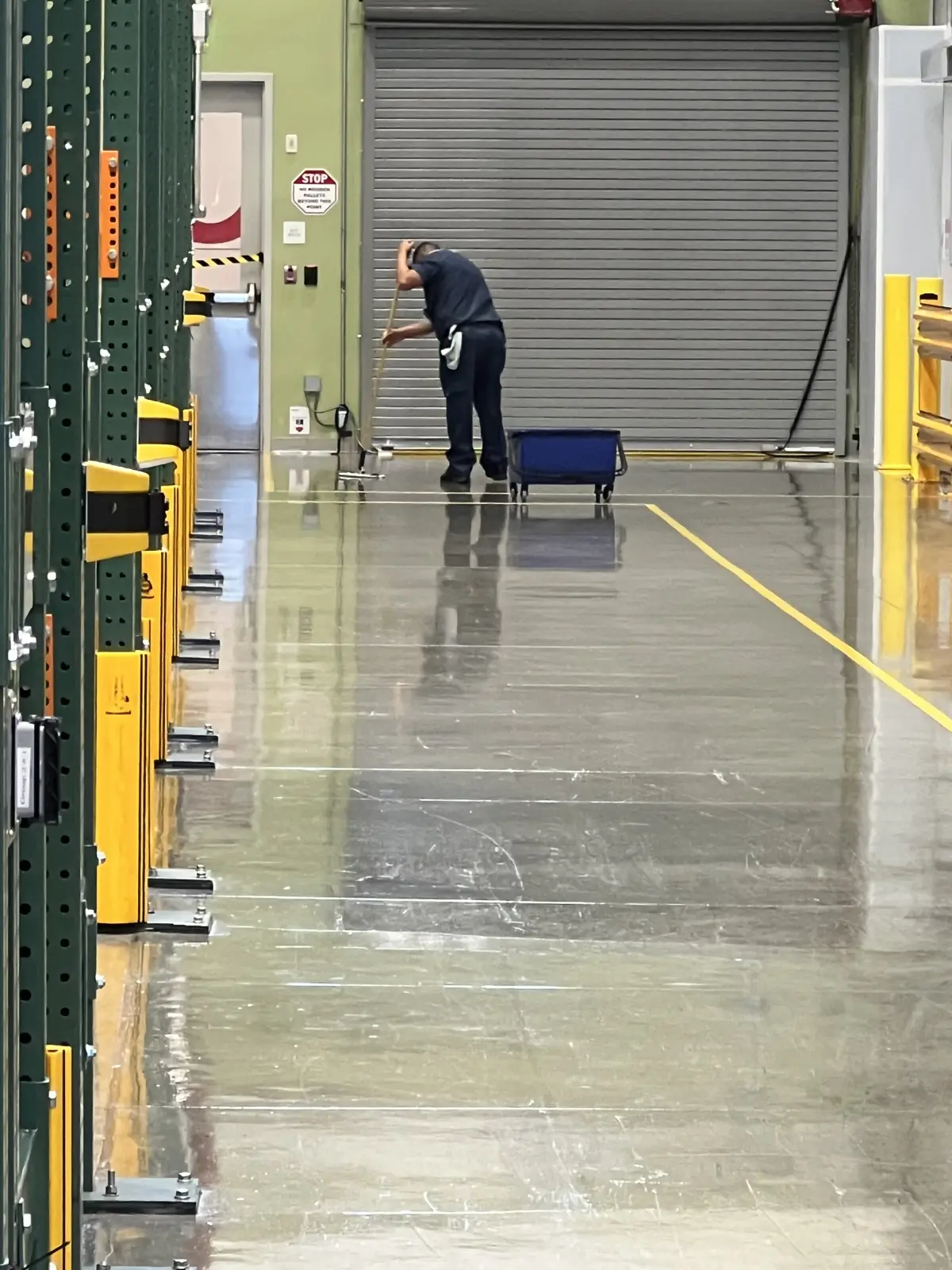
Grit that isn't swept outside comes in through the roll-up doors on tires and boots. The interior crew ends up fighting it every night, so a loose outdoor schedule shows up in your manufacturing and warehouse cleaning program too.
What time of day should sweeping happen?
For the car lot, overnight or before the first shift arrives. Sweepers need open pavement, and parked cars hide most of the debris you're paying to remove.
Truck courts are harder at sites that run around the clock. We typically schedule them during the lightest shift and work around the doors that are active, coming back for staged trailers once they pull out. Coordinate with each tenant's shipping lead so the sweeper isn't blocking a door at the wrong moment. If a tenant has a fixed outbound window, write it into the scope.
When should you add passes outside the schedule?
Inland Empire weather moves debris around more than most people plan for. Add a pass:
- After strong wind events, when trash and leaves pile against fences, curbs and dock doors
- Before the first rain of the season, with every storm drain inlet checked and cleared
- After a tenant moves in or out, since move days leave packaging and pallet debris behind
- Before an audit, a customer visit or a property tour
The pre-rain pass matters most. Whatever is on the lot when it rains goes toward the drains. California's State Water Board has a statewide program focused on keeping trash out of state waters (Trash Control), and cities pass those expectations down to properties. Sweeping is the part a property controls.
What should the sweeping scope say?
A line that reads "sweep lot weekly" doesn't tell you much. A usable scope lists:
- Each zone by name, marked on a site plan
- Frequency for each zone
- Time windows, including any tenant shipping windows to avoid
- Storm drain inlet checks on every visit
- Hand pickup for landscaped edges, planters and fence lines the sweeper can't reach
- Who to notify about hazards found, like pallet nails, broken concrete or a spill
- Proof of service, such as a visit log or photos
Sweeping also isn't stain removal. Oil spots and tire marks need pressure washing on its own schedule. Sweeping first keeps that work from being spent on loose grit.
Where Nexara fits
We run parking lot sweeping for industrial and commercial properties across the Inland Empire and Southern California, scoped zone by zone with drain checks on every visit. If your truck courts and your car lot are on the same schedule today, request a walkthrough and we'll map the zones with you.
Questions we get asked.
How often should an industrial park parking lot be swept?
Most industrial parks sweep truck courts and dock aprons weekly and car parking and drive aisles every one to two weeks. Busy distribution sites often add a second truck court pass during peak season.
What time of day should parking lot sweeping happen?
Usually overnight or very early morning, when the car lot is empty. Truck courts at around-the-clock sites are typically swept during the lightest shift, worked around active doors.
Should the schedule change before the rainy season?
Yes. Most properties add a full-site pass with storm drain inlet checks ahead of the first rain, because debris left on the lot is what washes into the drains when it does rain.